



























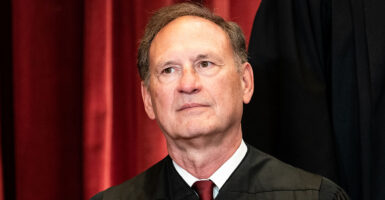
As rumors swirl that Supreme Court Justice Samuel Alito might retire at the end of this term, allowing President Donald Trump to name his replacement before the 2026 midterm elections, the justice could not have wished for a better send-off than Mollie Hemingway’s masterful and well-researched biography.
“Alito: The Justice Who Reshaped the Supreme Court and Restored the Constitution” captures Alito’s life story, his rise to the nation’s highest court, his judicial philosophy, and how the stars aligned to enable him to write the opinion that overturned Roe v. Wade (1973).
Hemingway, editor-in-chief of The Federalist and senior journalism fellow for Hillsdale College, writes that an old Latin phrase best captures Alito’s fearless determination to follow the law: fiat justitia, ruat caelum, which translates to “let justice be done though the heavens fall.”
When Alito wrote the opinion in Dobbs v. Jackson Women’s Health Organization (2022), the heavens did appear to fall. A hostile news outlet published the full draft opinion, and pro-abortion activists launched a horrific pressure campaign to stop the opinion’s finalization. Vandals targeted pro-life pregnancy centers and Catholic churches, and many began protesting outside of justices’ homes. At least one agitator attempted to assassinate a justice.
“In spite of political threats to the legitimacy of the court—accompanied by very real threats to the justices’ own lives—Alito had quietly and consistently delivered justice while also anchoring the team through its most controversial decision in half a century,” Hemingway writes. “The heavens had fallen, and Alito had done his duty, unawed.”
Who Is Alito?
After setting the stage with Dobbs in the introduction, Hemingway delves into Alito’s history. The justice grew up in an Italian American Catholic family in New Jersey, served in the military during the Vietnam War, and distinguished himself as a brilliant legal mind early on. Unlike Chief Justice John Roberts, he didn’t play the game to try to get nominated to the Supreme Court, but lightning struck and President George H.W. Bush gave him the opportunity.
Hemingway describes Alito as an “improbable justice.” While many Washington politicos succeed through “relentless diplomacy and self-promotion,” Alito “arrived at his position solely because of his intellect and hard work.”
While telling Alito’s story, Hemingway interweaves important details about the legal profession, explaining why the philosophy of Originalism—returning to the original public meaning of the Constitution—became so important.
‘The Best Court’
Hemingway next recounts the building of “the best court in history.”
She traces the history of each member of the current court, from Democrat nominees like Sonia Sotomayor, Elena Kagan, and Ketanji Brown Jackson to the Republican nominees from President Donald Trump’s first term and before: Clarence Thomas, John Roberts, Neil Gorsuch, Brett Kavanaugh, and Amy Coney Barrett. She analyzes each justice’s character and role on the bench.
Hemingway praises Justice Kagan as “the smartest liberal justice,” and a “formidable writer.” She warns about Justice Barrett’s “characteristic caution,” and heavily criticizes Chief Justice Roberts for essentially rewriting the Affordable Care Act (better known as Obamacare) on the fly to save it in 2012.
“Roberts never publicly supported the conservative legal movement in speeches and was never associated with its organizations, yet he skillfully conveyed the message that he was conservative,” Hemingway notes. Roberts seems too concerned with how the media perceives him, and Hemingway warns that his bowing to “political pressure politicized the court and encouraged similar pressure campaigns in the future.”
After setting up the court’s composition, Hemingway delves into Alito’s judicial philosophy as a “practical Originalist.” While Alito aims to restore the original public meaning of the Constitution, his approach differs from Justice Thomas.
Thomas “plants a flag where he believes the court should be,” laying out “his vision in his opinions” and hoping to move the legal culture to catch up, but Alito “is more interested in the tactical work of assembling a majority to seize new ground today.” Hemingway notes that Alito’s history as a circuit court judge prepared him to deal with concrete cases more than abstract principles.
Overturning Roe
Hemingway breaks down the complex ecosystem of abortion law and the Supreme Court’s previous futile attempts to address it, before narrating Alito’s central achievement.
She recounts the many courageous decisions that had to happen in order to reverse Roe. She recounts how Roberts and Justice Stephen Breyer tried to peel Justice Brett Kavanaugh off the decision.
In the end, the court overturned Roe, and Alito shepherded this key win through a complex process. It took a man of undaunted principle and unflinching courage to achieve this massive victory—and to stick by it, under pressure.
The full character of that man emerges from Hemingway’s prose, and Americans will be educated and edified by her masterful work.
If Alito does decide to retire, this book will help him do it on a high note.

